 |
| A great graphic courtesy of http://greatist.com. I'm always down for OPG (other people's graphics). |
Showing posts with label diet. Show all posts
Showing posts with label diet. Show all posts
Friday, January 25, 2013
A Great Sports Nutrition Infographic

Thursday, December 13, 2012
The Trouble with Diet and Exercise Studies
The Trouble with Diet and Exercise Studies
A wiser man than myself once said there are "...lies, damned lies, and statistics.", add broadly interpreted conclusions to that statement and it applies to the world of fitness pretty well. Don't get me wrong, I'm a firm believer in the role of both science and statistical analysis in the word of health and fitness; however, conclusions should be arrived at carefully.
So what's my beef with all these studies? Let me break it down:
Population
Typically, the survey populations in fitness studies are either high-level athletes or healthy, but completely untrained people. While both these groups are certainly worth studying, the results you get will lead you to conclusions that may or may not apply to everyone else. Untrained individuals will likely respond to almost any new stimulus added to a workout program. Conversely, high level athletes will require more stimulus, are motivated, have a higher pain tolerance, a higher work capacity, and are more likely to be genetically gifted.
For example: There was a study several months ago that showed muscle growth in 15 "recreationally active" individuals lifting 30% of their on-rep max. The problem with this study is twofold:
1. 15 people isn't exactly a massive sample size.
2. I take "recreationally active" to mean healthy, but untrained which means they could probably look at weights and improve strength and muscle size.
Based on experience and observation I have never seen anyone gain a significant amount of muscle or strength lifting that low a percentage of their max. To the credit of the researchers, the weights were lifted to failure which with training, would take a long time and just isn't that efficient way of training once you become somewhat conditioned.
Is this study completely without value? If it's your conclusion that you should be training with 30% of your max then yes. If your conclusion is that there is more than one way to skin a cat and that higher reps can sometimes be effective then no. I think there is something to be said for training with higher repetitions, just not that high, for everybody, all the time.
A wiser man than myself once said there are "...lies, damned lies, and statistics.", add broadly interpreted conclusions to that statement and it applies to the world of fitness pretty well. Don't get me wrong, I'm a firm believer in the role of both science and statistical analysis in the word of health and fitness; however, conclusions should be arrived at carefully.
So what's my beef with all these studies? Let me break it down:
Population
Typically, the survey populations in fitness studies are either high-level athletes or healthy, but completely untrained people. While both these groups are certainly worth studying, the results you get will lead you to conclusions that may or may not apply to everyone else. Untrained individuals will likely respond to almost any new stimulus added to a workout program. Conversely, high level athletes will require more stimulus, are motivated, have a higher pain tolerance, a higher work capacity, and are more likely to be genetically gifted.
For example: There was a study several months ago that showed muscle growth in 15 "recreationally active" individuals lifting 30% of their on-rep max. The problem with this study is twofold:
1. 15 people isn't exactly a massive sample size.
2. I take "recreationally active" to mean healthy, but untrained which means they could probably look at weights and improve strength and muscle size.
Based on experience and observation I have never seen anyone gain a significant amount of muscle or strength lifting that low a percentage of their max. To the credit of the researchers, the weights were lifted to failure which with training, would take a long time and just isn't that efficient way of training once you become somewhat conditioned.
Is this study completely without value? If it's your conclusion that you should be training with 30% of your max then yes. If your conclusion is that there is more than one way to skin a cat and that higher reps can sometimes be effective then no. I think there is something to be said for training with higher repetitions, just not that high, for everybody, all the time.
Thursday, October 13, 2011
Recovery
One of the most important but underrated aspects of physical fitness is recovery. Recovery is when the physical adaptation to exercise and the neural "reprogramming" occur. For the purposes of this post, I'm talking about recovering after a competitive event, peaking after a training cycle, or an exceptionally difficult workout. Before I get started, remember, the better condition you’re in, the shorter your recovery will be.
So you've completed your training-cycle/event/workout what’s next?
So you've completed your training-cycle/event/workout what’s next?
- ASAP: If you feel like you may have injured yourself or there is a spot that typically bothers you (example: Bum knee or chronic tendonitis), get ice on it.
- ASAP: Hydrate, especially if you are in warm conditions or completed a long endurance activity.
- <1 hour: Eat something to help replenish glycogen stores and prevent muscle catabolism. Preferably something with carbs and complete (animal) proteins. I've heard the magic ratio is 4:1 carbs to proteins. Chocolate milk fits those criteria well, so do some sports drinks like Accelerade that mix sugars and protein. Most importantly, just eat. Eating anything is still better than nothing.
- 0-24 hours: Stretch and massage. This is dependent on personal preference, but I find doing light stretching and self massage with a foam roller to be useful.
- That day: Sleep.
- In the days after: Active recovery and cross-training. This can be as simple a walk and stretching. The purpose is to get blood flowing to your muscles and connective tissue.
Tuesday, September 27, 2011
The Little Things
As much as I think everyone should exercise for hours on end everyday that's really not practical for many of us. Additionally, there really isn't any reason why most sane people should do that much exercise. There are however, little things that go a long way in maintaining health and fitness in normal people.
Let’s talk about the difference between health and fitness. "Health" implies your bodies systems functioning normally, while "fitness" implies the ability to perform certain tasks. You can be "healthy" in general while not being "fit" for a given task and visa versa. A professional boxer is certainly fit, but there is nothing healthy about getting hit in the head for a living.
Fitness is more specific and dependent on activity. The fitness needs of a 25 year old NFL linebacker are different from that of a 50 year old marathon runner, a 35 year old playing pick up basketball, a 27 year old mother of a new born, or a 70 year old who just wants to bring groceries up their stairs.
Let’s talk about the difference between health and fitness. "Health" implies your bodies systems functioning normally, while "fitness" implies the ability to perform certain tasks. You can be "healthy" in general while not being "fit" for a given task and visa versa. A professional boxer is certainly fit, but there is nothing healthy about getting hit in the head for a living.
Fitness is more specific and dependent on activity. The fitness needs of a 25 year old NFL linebacker are different from that of a 50 year old marathon runner, a 35 year old playing pick up basketball, a 27 year old mother of a new born, or a 70 year old who just wants to bring groceries up their stairs.
Monday, September 12, 2011
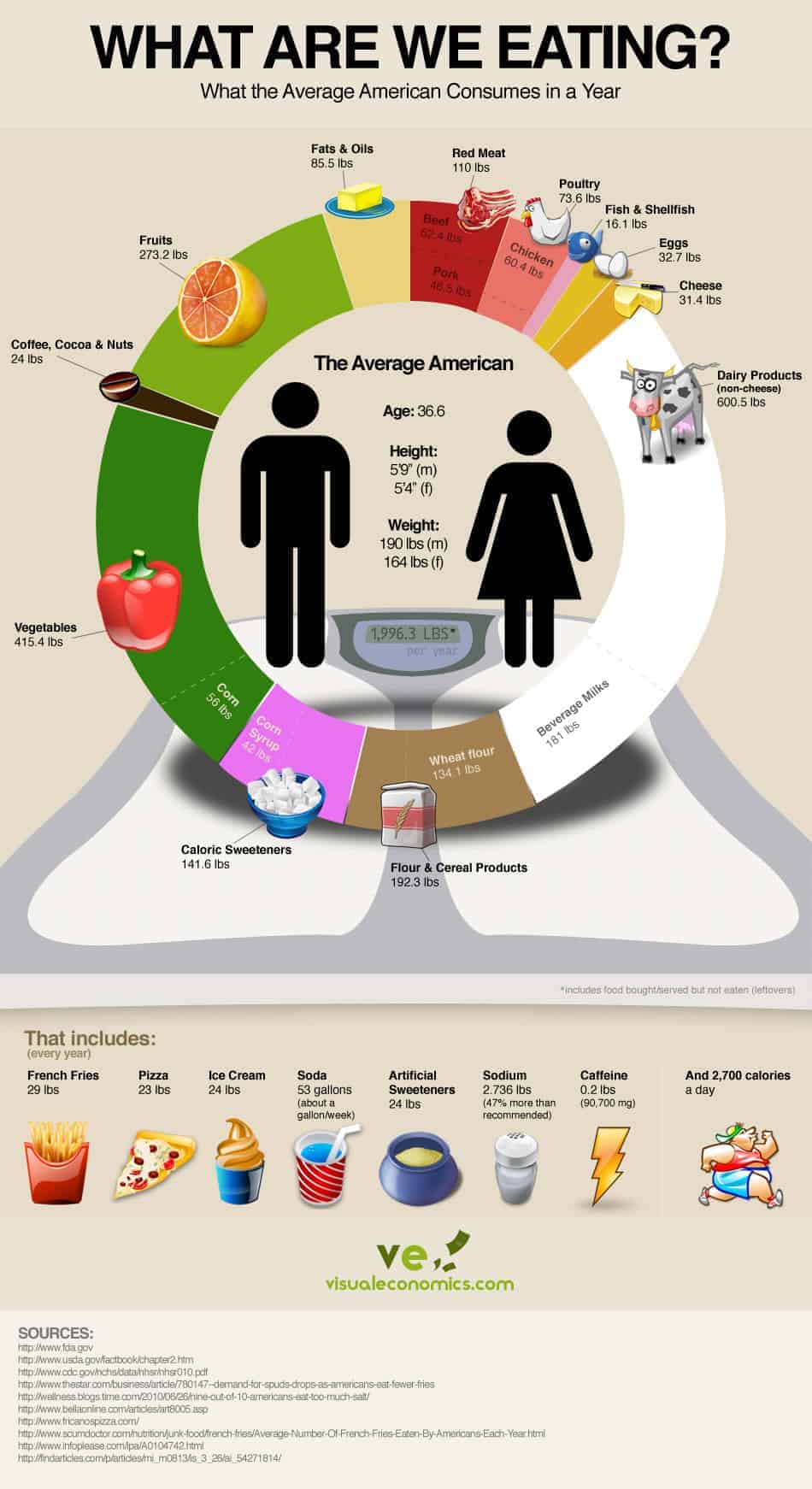
What We Eat

Thank you Visual Economics for the great graphic (click here for the full size version).
Subscribe to:
Posts (Atom)